 English
 Albanian
 French
 German
MikaCUT
Cutting Optimisation and Order Platform
Every screen, explained
These are real screens from the running application. Select a point to see what it does, why it is there, and what it changes on the floor.
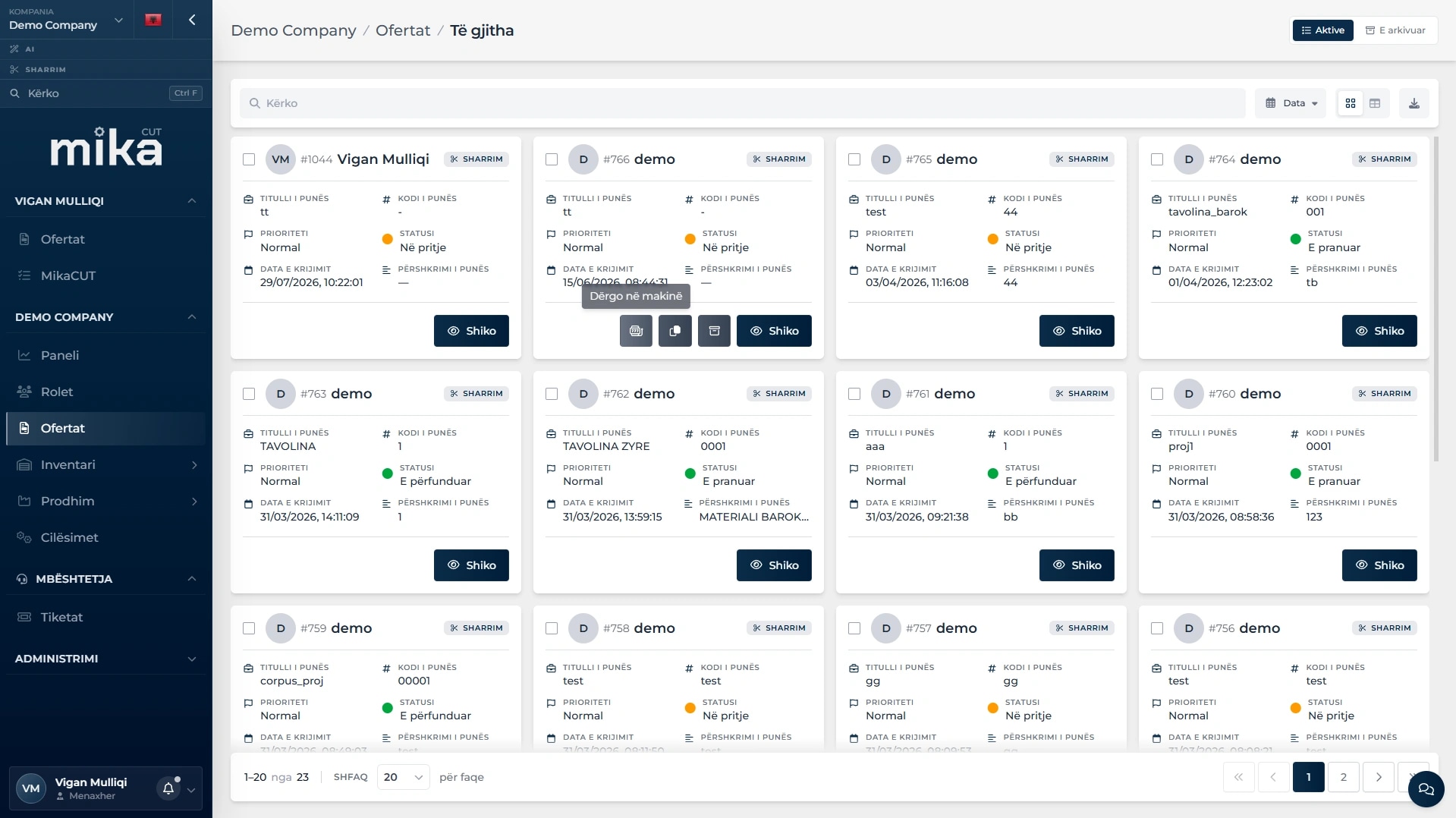
Every job in the workshop as a card. Title, code, priority and where it has reached, without opening anything.
Select a numbered point on the screen to see what it does.
Where the job has reached
Each offer carries a state: pending, approved or finished, shown on the card itself.
A quotation that has not been answered and a job that is already cut are completely different problems, and both live in the same list.
The morning question, what needs chasing and what needs cutting, is answered from one screen.
Job title and code
A human title and your own order reference, kept side by side on every offer.
The office searches by customer name, the floor searches by order number. Forcing one of them to translate is where jobs get mixed up.
Both sides find the same job with the term they already use.
Cards or table
The same list as scannable cards or as a dense table, plus export.
Twenty open jobs want cards. Two thousand archived ones want a table you can sort and export.
The list scales from a small workshop to a full order book without a second tool.
Select a numbered point on the screen to see what it does.
Length, width, material, quantity
One row per part. The optimiser needs nothing more than these four columns to produce a layout.
Cutting software often demands a full product model before it will do anything. Most jobs are a list of rectangles, and pretending otherwise slows the office down.
A quotation can be optimised in minutes, not after a full design exercise.
Edge banding on four sides
ABS 1 to 4 record which edges of the part are banded, and with what.
Edge banding changes the finished size. A part banded on two edges has to be cut smaller than one that is not, or the door does not close.
The cut size accounts for the banding, and the banding is costed with the job rather than remembered later.
Grain direction
Whether a part must follow the grain of the board, or may be rotated freely.
A layout that ignores grain packs beautifully and produces a wardrobe with one door running the wrong way. It is the most expensive kind of optimisation error, because it is only visible when assembled.
Yield is never bought at the price of a visible defect.
Optimise, waste, stock
The job-level actions: run the optimiser, review waste, and declare one-off material for this job only.
Optimisation is not the last step. It is run, read, adjusted and run again while the quotation is still being negotiated.
Price and yield can be tested against each other before anyone commits to a panel.
Select a numbered point on the screen to see what it does.
CSV import
Production measurements imported from a CSV, including exports from Corpus and from MikaMES.
Cabinet design already produced this list once. Typing it again is where transcription errors enter the job.
The list that gets cut is the list that was designed, with no retyping between them.
A MikaMES agreement can be exported straight into the offer, so the order and the cutting job start from the same measurements.
Scan a paper list
Photograph a handwritten or printed measurement list and it is read into the offer.
Measurements are still taken on paper in a customer kitchen. Refusing to accept that is how software gets abandoned.
The measurer keeps working the way they always have, and the office does not retype the sheet.
Blank template
A printable measurement sheet, laid out so a photograph of it reads accurately.
Reading handwriting is far more reliable when the handwriting sits in known boxes.
One sheet in the van turns paper measuring into a reliable digital input.
Select a numbered point on the screen to see what it does.
One entry, one physical piece
Each row is a single real board with its own material and size, consumed when the optimiser uses it.
Stock assumes an unlimited supply of a standard size. A single odd board breaks that assumption, and it happens on most jobs.
Odd material is used up first without polluting the permanent stock list.
Everything is optional
Material, length and width can each be left blank.
The person entering this is often standing next to the board with a tape measure and no idea of the exact decor code.
Partial information is accepted rather than blocking the job until someone finds the label.
Select a numbered point on the screen to see what it does.
Optimisation level
Four levels: Standard, Advanced, Expert and AI. AI runs every strategy at once and keeps the best result.
A rush job and a large batch do not deserve the same amount of computing time. The level is the trade between how long the optimiser thinks and how tightly it packs.
Set it once for the company. Nobody has to understand cutting algorithms to get a good layout.
Use offcuts
Leftover offcuts from previous jobs are treated as available stock material, not as waste.
In most workshops the offcut rack is real inventory that nobody has counted. The optimiser can only use what the system knows exists.
The second job pays for the first one’s waste. Full panels are only bought when nothing on the rack fits.
Offcuts produced on the saw are reported back by MikaIOT, which distinguishes them from finished parts, so the rack stays accurate without anyone counting it.
Full edge-to-edge first cut
Forces the first cut to run the full width of the sheet, splitting it into strips before anything else is cut.
Some saws and some operators want strip-first cutting. This is a machine constraint, not a preference, and the layout has to respect it or the program cannot be run.
Layouts arrive at the saw already cuttable, so the operator is not re-planning them at the machine.
Impact readout
Selecting any strategy explains it in full and marks what it costs and what it gains, here speed up and material yield down.
Every optimisation setting is a trade. Hiding that behind a toggle makes people switch things on without knowing what they gave up.
Decisions are made with the trade visible, so a setting chosen for speed is a choice rather than an accident.
Select a numbered point on the screen to see what it does.
Used area against waste
Square metres used and square metres wasted, as an area and as a percentage of the panels consumed.
Material is the largest cost in a panel job. A yield figure is the difference between quoting from feel and quoting from measurement.
A poor layout is visible before the panel is cut, while there is still time to add a part or change the sheet size.
The cut list, in order
Every cut the saw will make, in sequence, with its length: trims first, then each cutting level.
A layout only means something if the saw can actually reach every cut in a valid order. This is the list the machine will follow.
The operator can read the plan before running it, and total cut length gives a real estimate of time on the saw.
Kerf thickness
The width of material the blade itself removes, applied to every cut in the layout.
A 4.4 mm blade across nine cuts removes almost 40 mm of panel. Optimisers that ignore kerf produce layouts that look perfect and come up short on the last part.
The layout is dimensioned for the blade actually fitted to your saw.
Wasted panels
The remainder of each sheet, listed separately from the parts, so recoverable pieces can be identified.
Waste and stock look identical on a saw table. If the software does not separate them, the good piece goes in the skip.
The offcut rack fills with pieces the system can find again on the next job.
These become available stock for the optimiser, closing the material side of the loop.
Core Modules
Precision engineered tools designed to optimize performance, streamline operations, and deliver measurable efficiency.
Offers
Every job lives as an offer: measurements, materials, pricing and cutting result in one record, from quotation through to export.
Optimiser
Nests parts across panels and reports yield and waste per layout. Strategy is configurable per company, not per job.
Offcut reuse
Usable offcuts from finished jobs return to stock and are offered to the optimiser as real material on the next job.
Inventory
Materials, panel stock and edge banding in one place, with stock updated when a job is sent to the machine.
Machine export
Pick the machine, choose which programs to send and in what order, and export the exact file set the controller expects.
Operator board
A shop-floor screen showing what is queued, what is running and what is finished, without an operator opening the office system.
The rest of the system
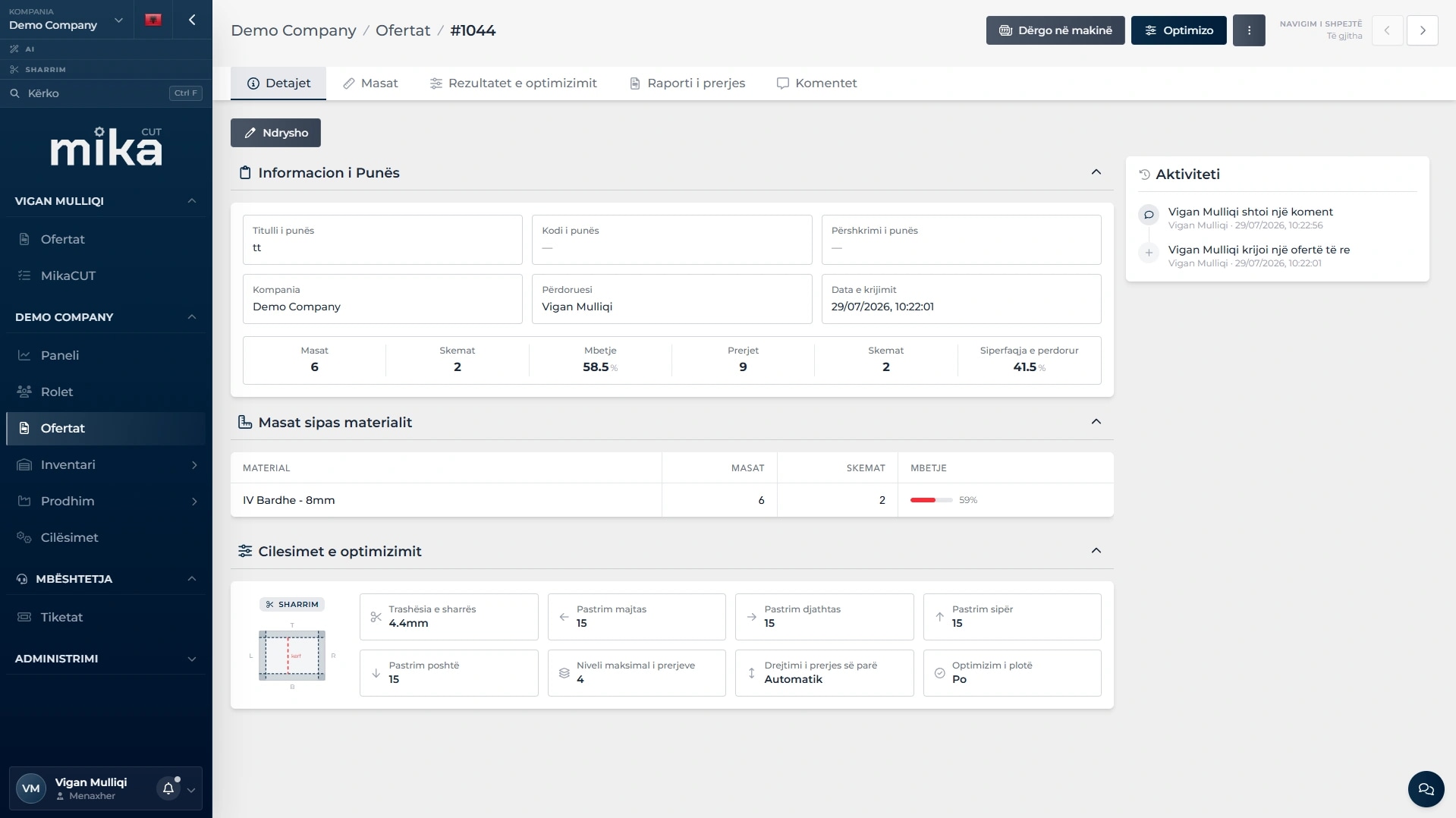
The job at a glance
Parts, layouts, waste, cuts, sheets consumed and used area on a single line, alongside the exact optimisation settings the result was produced under: kerf, the four trim values, cut depth, first cut direction. Company defaults change over time, so a job that cannot recall its own settings cannot be re-run or explained. Every result here is reproducible months later, which is what makes a disagreement about a delivered job something you can settle rather than argue.
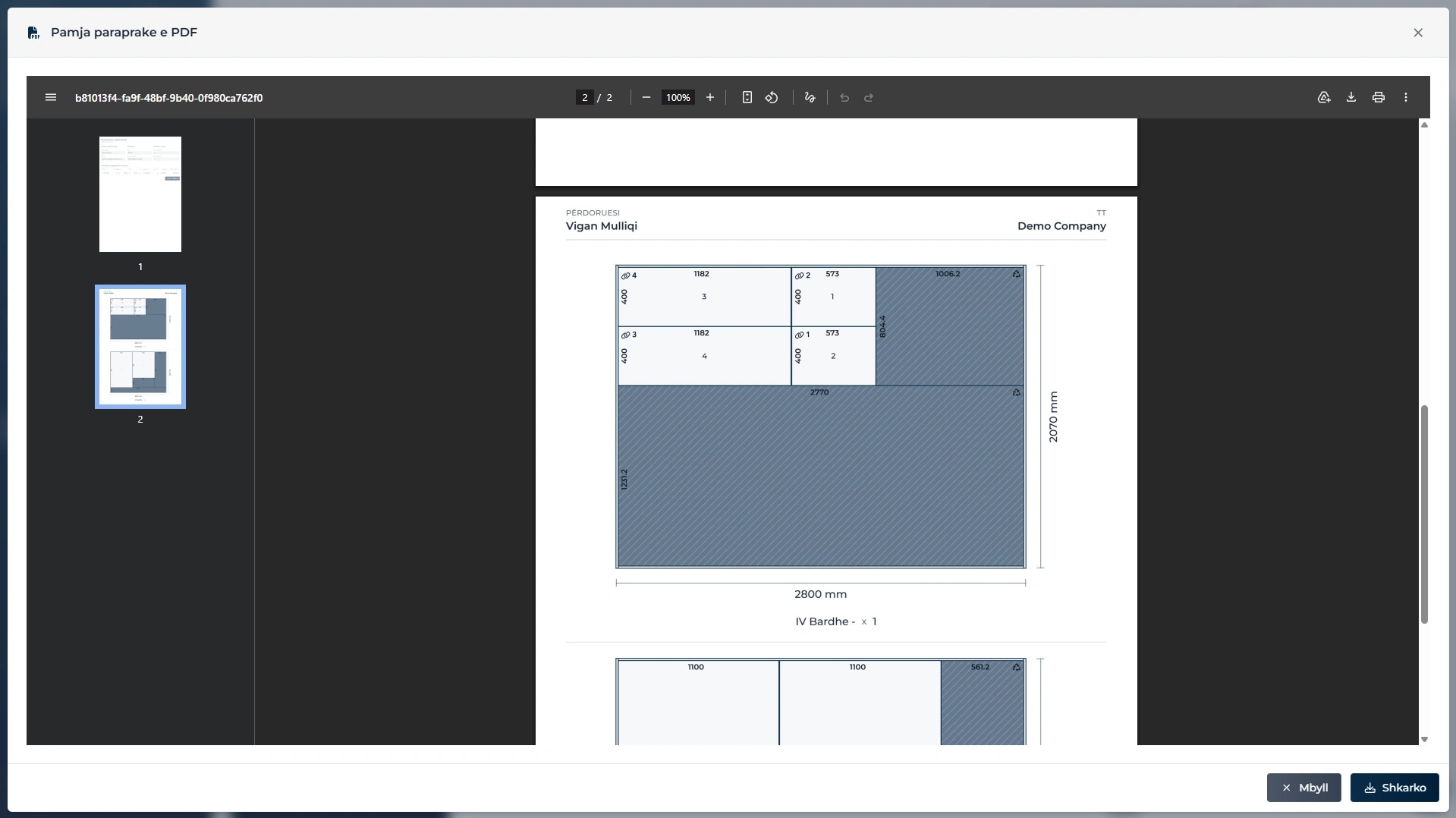
Export the offer as PDF
The document the workshop runs on. One page per cutting layout, fully dimensioned, with reusable offcuts marked so the operator can tell recoverable stock from waste before it reaches the skip. Preview every page before it leaves, then print it for the saw or send the PDF to the customer. What you see in the preview is exactly what the operator receives.
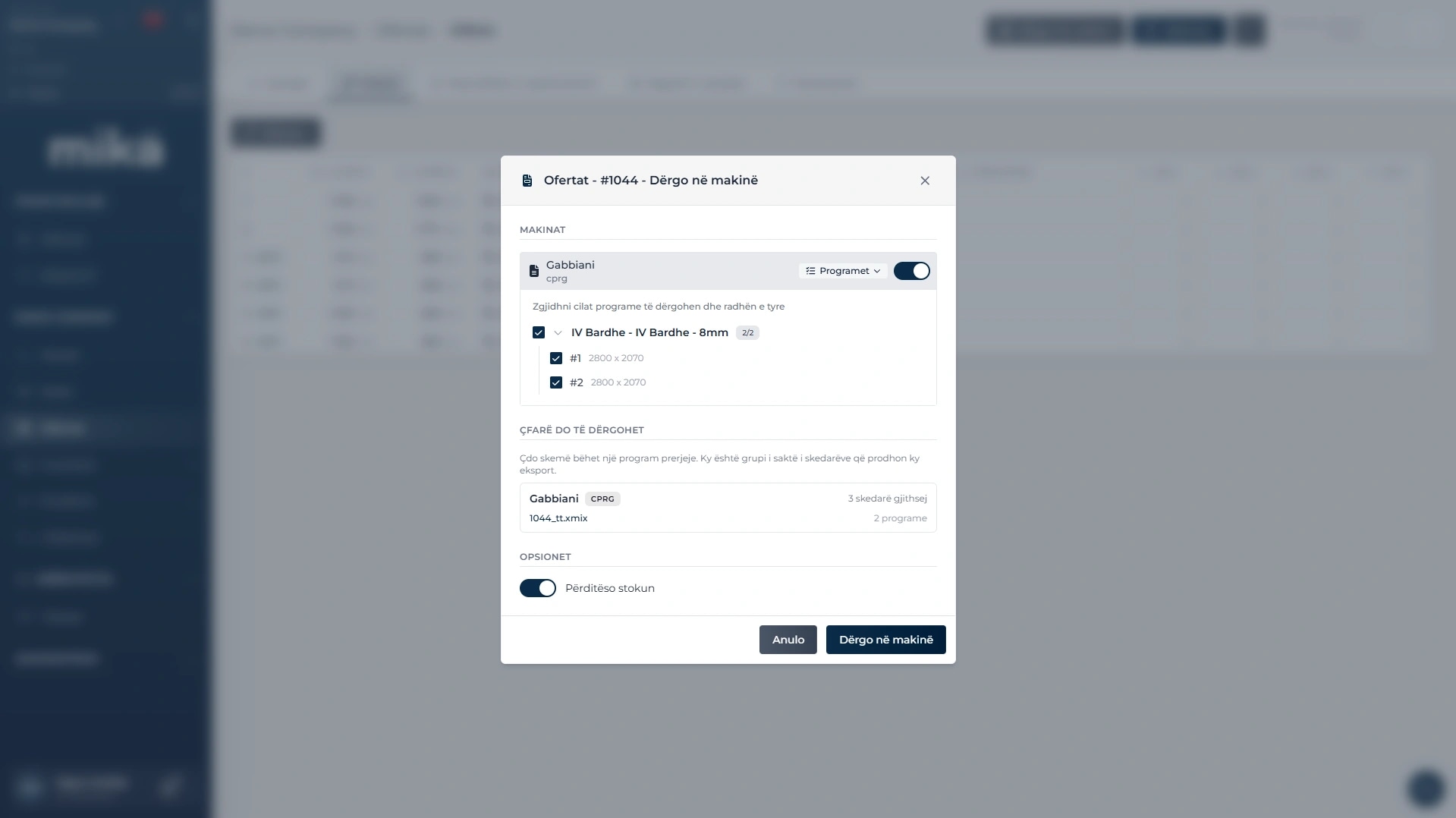
Send to machine
The handover from office to factory floor. Every layout becomes one cutting program, and you choose which programs go and in what order, because cutting sequence is a production decision that depends on material on hand and what the next station needs first. The exact files are named and counted before anything leaves, and sending the job draws the panels it consumes out of inventory in the same action.
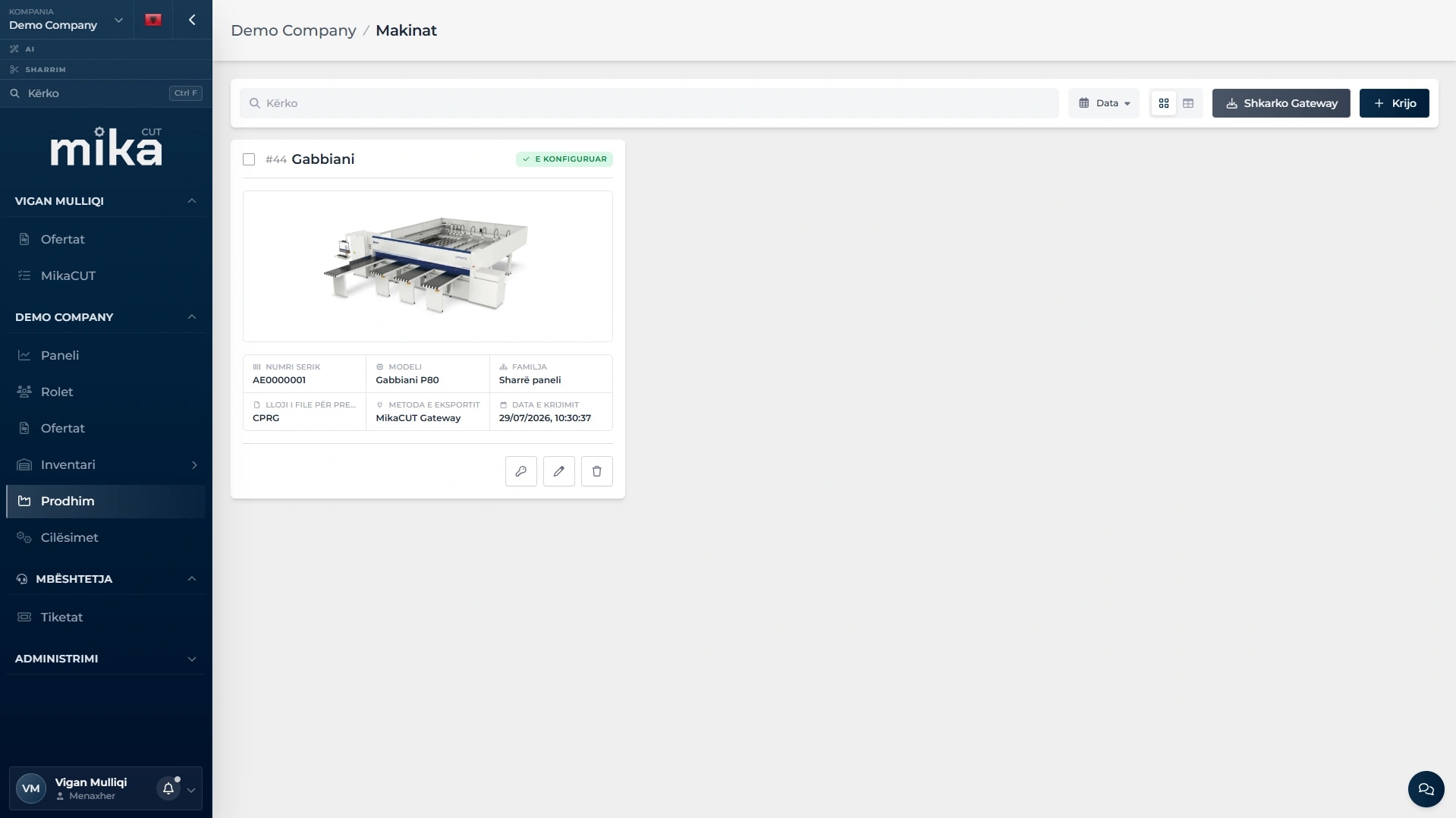
Your machines
Every machine registered once, with its real serial number, model, family and the export format its controller reads. Controller generations differ inside the same brand and often inside the same factory, so the format is recorded per machine rather than as one company-wide setting that eventually sends the older saw the wrong thing. Machines connect once, and from then on jobs go out and results come back on their own.
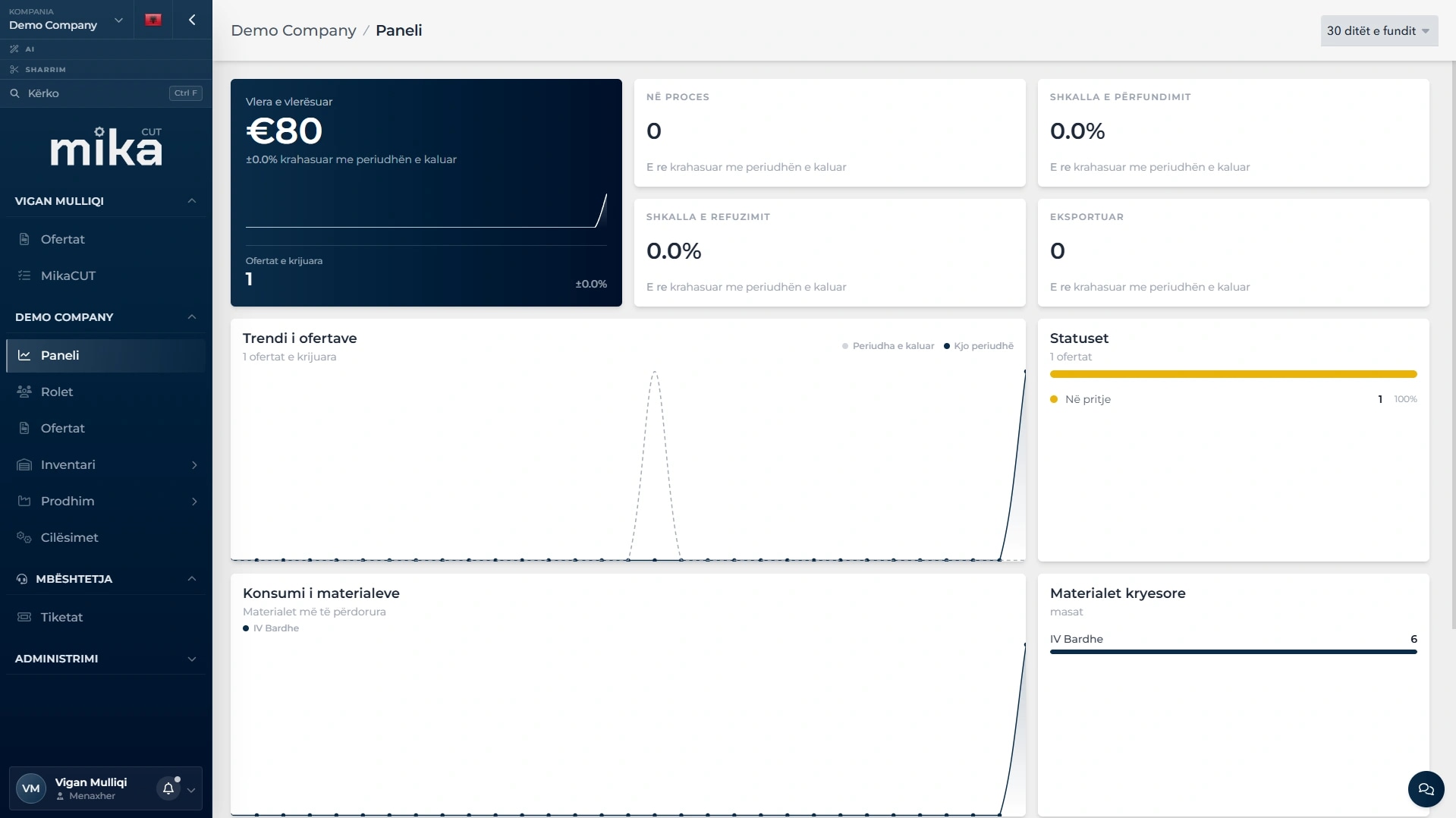
Company dashboard
What the company looks like above a single job: value quoted in the period, the offer trend, how many jobs were won against how many were refused, and which boards the factory actually consumes, ranked. A high rejection rate on accurate pricing is a market problem; on inaccurate pricing it is an optimisation problem, and the two need telling apart. Purchasing usually runs on habit, and ranked real consumption is what turns a stock order into a decision.