 English
 Albanian
 French
 German
MikaMES
Manufacturing Execution System
Every screen, explained
These are real screens from the running application. Select a point to see what it does, why it is there, and what it changes on the floor.
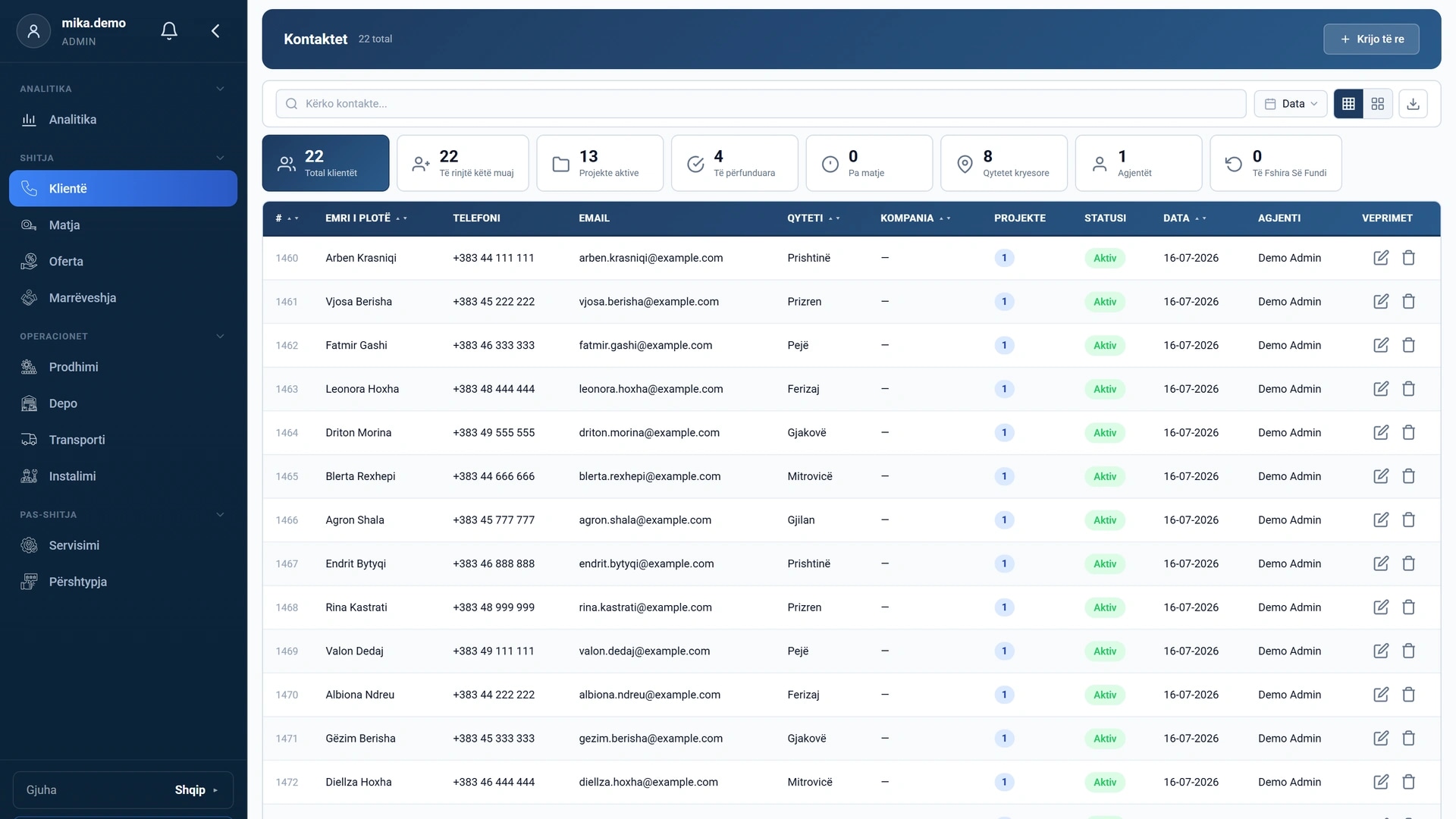
Every contact the business has, and the state of the relationship, before anything has been quoted.
Select a numbered point on the screen to see what it does.
Clients with no measurement
A live count of contacts who have been taken on but never measured.
This is where deals die quietly. Nobody chases a client who is not yet a quotation, because they do not appear on any sales report.
The gap between interest and a measurement becomes a number somebody owns.
Projects per client
How many separate jobs sit under each contact.
A kitchen and a wardrobe for the same customer are different jobs with different dates, and collapsing them into one record is how one of them gets forgotten.
Repeat customers stay one relationship with many jobs, not many half-duplicated contacts.
Who owns the contact
The agent responsible, recorded on the row.
A contact with no owner is a contact nobody calls back, and the customer only notices when they have already gone elsewhere.
Follow-up is assignable rather than assumed.
Search and export
Full text search across contacts, with the filtered result exported.
The customer list is the one asset a business keeps if it changes every other system, so it has to be able to leave.
Your data stays yours.
Select a numbered point on the screen to see what it does.
Provisional against final
Measurements split into waiting, provisional and final.
A provisional measurement priced as final is the most expensive mistake in the business: the offer is signed, then the wall turns out to be 40 mm out.
Nothing reaches an offer on numbers that were never confirmed.
What is being measured
The job in the customer own words: a kitchen with a central island, a hotel reception counter, shelving for a shop.
Job codes mean nothing on the phone. The person who took the measurement remembers the room, not the reference.
Anyone can find a job the way the customer would describe it.
When, and by whom
The date the measurement was taken and the agent who took it.
When a part does not fit on site, the first question is whether the room changed after the measurement or the measurement was wrong.
That question has an answer instead of an argument.
Select a numbered point on the screen to see what it does.
Status and responsibility
Where the offer has reached, who owns it, and the installation date being promised.
An offer with no owner is an offer nobody chases. An install date set here is the date production plans against, not a number in an email.
The promise and the plan are the same record from the moment it is made.
Offer documents
The initial offer, the revised offer, the final offer and the client requirements, kept together and versioned.
Furniture quotations are negotiated two or three times. When a dispute arrives six months later, the question is always which version was agreed.
Every revision is on the record, so the agreed version is never a matter of memory.
Terms of the offer
Validity, payment split, lead time, VAT, what transport and assembly include, and the warranty.
These are the clauses every argument is actually about, and they are usually pasted from the last quotation with one number left wrong.
They travel with the offer rather than being retyped each time.
The conversation
Internal notes kept against the offer itself rather than in somebody inbox.
The reason a price was dropped is the single most useful thing to know a month later, and it is the thing least likely to be written down.
Context survives the person who had it.
Select a numbered point on the screen to see what it does.
The committed order book
Waiting, in production, in the warehouse, completed and cancelled, counted across every signed agreement.
Signed work is money already promised. Knowing how much of it is still on the floor is a different question from how much has been quoted.
Capacity is planned against contracts, not against hopes.
Where each contract stands
A state per agreement, moving from waiting through production to the warehouse and completion.
A customer never asks about a process, they ask about their kitchen. The state has to exist at the level the customer thinks in.
Anyone answering the phone can answer it without asking the floor.
The delivery date
The date promised in the contract, carried on the row rather than buried in the document.
The promised date is the one number the whole factory is scheduled against, and it usually lives only in a signed PDF nobody reopens.
Production plans against the promise instead of around it.
The delivery calendar
The same agreements laid out by date rather than as a list.
A list cannot show that four installations were all promised for the same Tuesday. A calendar shows it immediately.
Overcommitment is visible while it can still be renegotiated.
Select a numbered point on the screen to see what it does.
Process pipeline
Every product carries its own row of processes, from 3D design through cutting, edge banding, CNC drilling, finishing, assembly, fitting, quality control, packing and delivery.
Furniture is not made on a line. A wardrobe and a kitchen island pass through different stages in a different order, and a single progress bar cannot describe either.
When a customer asks where their order is, the answer is on screen at process level, not "in production".
A process running late
A stage that has passed its date is marked in place, against the client and product it belongs to.
Delay is only expensive when it is discovered late. The board is the place it is already being read every morning.
The delivery date is renegotiated while there is still time, instead of on the day of installation.
Filter by department
The same board narrowed to one group of processes: design, cutting and CNC, assembly, quality control and packing, or finishing.
A department head does not want the whole factory. They want their queue, in order, with the late ones first.
One board serves the whole factory and each department sees only its own work.
Client, project, product
Every row is tied to the client and the project it came from, with the ordered quantity beside it.
Production work orders that lose the customer make it impossible to answer a phone call without three lookups.
Sales and production read the same record, so nobody has to translate between an order number and a job.
Select a numbered point on the screen to see what it does.
The intake queue
Awaiting acceptance, in the warehouse, already dispatched, purchased items, internal stock and how many departments feed it.
Between a department finishing and the warehouse accepting, a product belongs to nobody. That gap is where work goes missing and where a day disappears.
The handover is a step with a name and a count, not an assumption.
Which department it came from
Every arriving item names the department that produced it, cutting and CNC, assembly, and so on.
When something is rejected, the argument is always about who produced it. Recording the source at intake settles that before it becomes a conversation.
Rework is attributable, so the same fault stops repeating.
How long it has been waiting
Time spent sitting in the intake queue, counted per item.
Finished goods waiting on a signature look exactly like goods still in production on every report that does not measure this.
A delay caused by paperwork is visible as paperwork, not blamed on the floor.
Accept or reject
Accepting moves the item into stock at the counted quantity; rejecting sends it back to the department that made it.
Partial deliveries are normal, three of three is not guaranteed, and a quantity accepted on trust is a shortage discovered at installation.
Stock reflects what was counted, so the van is loaded against a real number.
Kernmodule
Präzisionsentwickelte Werkzeuge, die darauf ausgelegt sind, die Leistung zu optimieren, Abläufe zu rationalisieren und messbare Effizienz zu liefern.
Kunden
Kontakte, Projekte und die vollständige Historie aller Angebote, Bestellungen und Lieferungen je Kunde.
Aufmaß
Aufmaße vor Ort werden am Projekt erfasst, sodass Angebot und Produktionsliste auf denselben Zahlen beruhen.
Angebote und Verträge
Aus Angeboten werden unterzeichnete Verträge, und aus einem Vertrag die Produktliste für die Fertigung.
Produktionstafel
Jedes Produkt gegen jeden Prozess, von der 3D-Konstruktion über Zuschnitt, Kanten, CNC-Bohren, Lackieren, Montage, Qualitätskontrolle bis Verpackung.
Lager
Materialverfügbarkeit gegen den tatsächlichen Bedarf der Fertigung, sodass Fehlteile sichtbar werden, bevor sie einen Prozess stoppen.
Transport und Montage
Lieferung und Montage schließen den Auftrag ab, der Kundendienst bleibt am selben Projekt hinterlegt.
The rest of the system
Transport
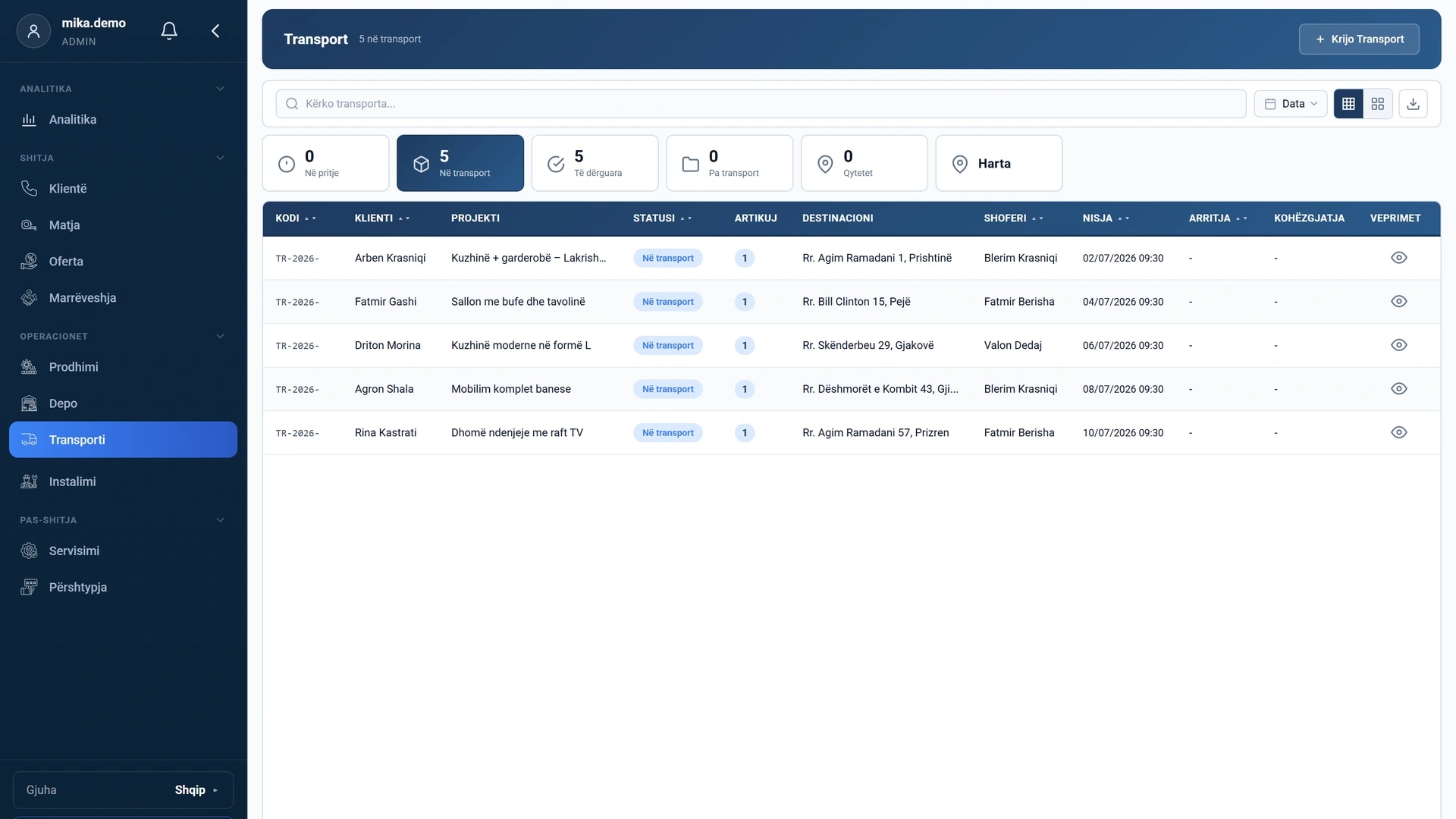
Finished goods leaving the building: what is on which van, going where, with which driver, and when it left and arrived. The module also counts what is complete but has no transport assigned, which is the quietest way to miss a delivery date, because the work is done and stops appearing on any production report while it sits in the warehouse. Delivery time is the part of the promise nobody measures, so it is the part that silently grows.
Installation
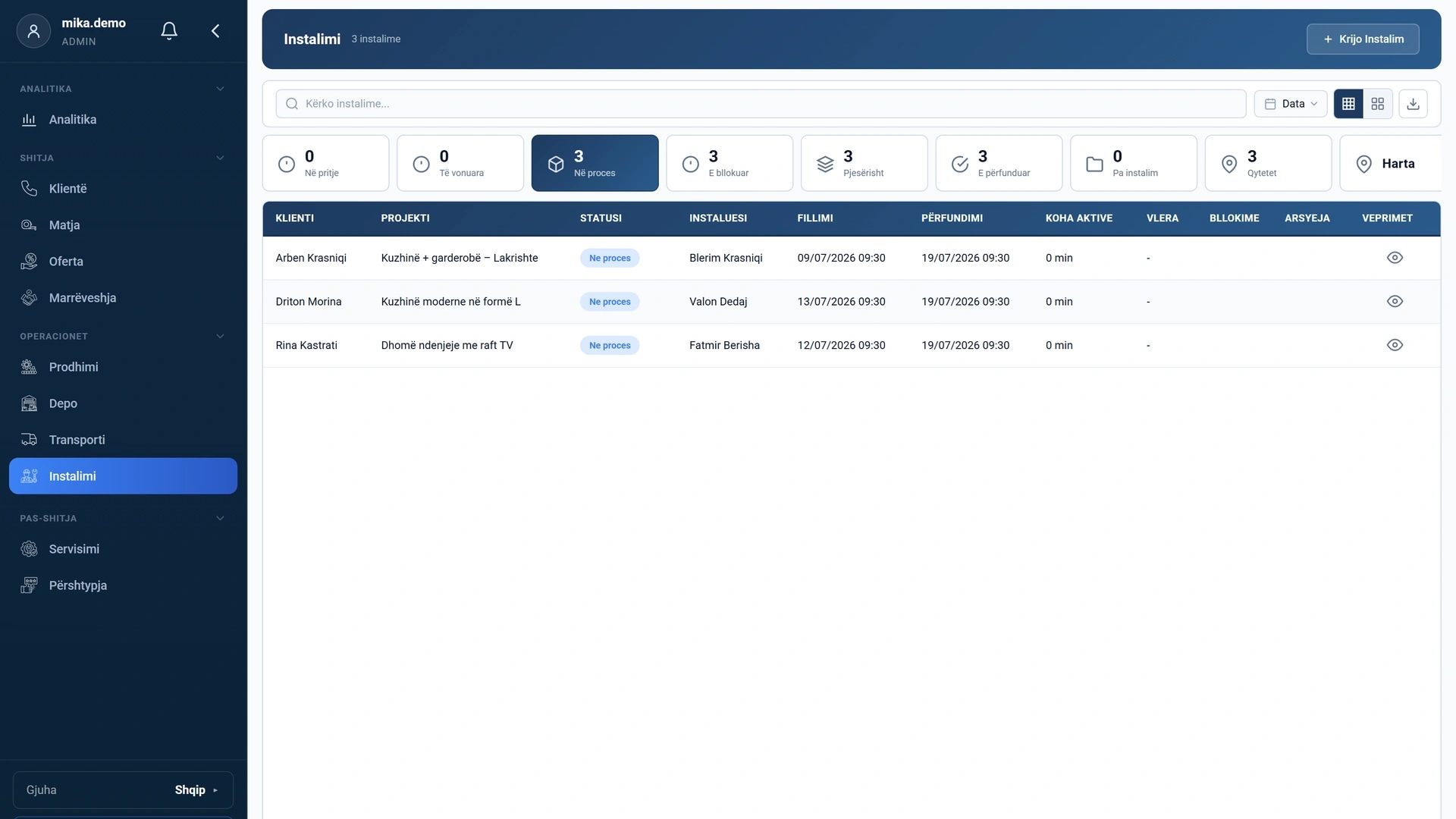
The last stage, on site, where an order is only finished when the customer's room is. Installations are counted separately when they are blocked, only partly done, or late, because most installation failures have nothing to do with the factory: the site is not ready, the electrician has not been, a wall is out of true. Recording the blocking reason against the job means the same three causes stop repeating instead of living in a phone call.
Where everything stands
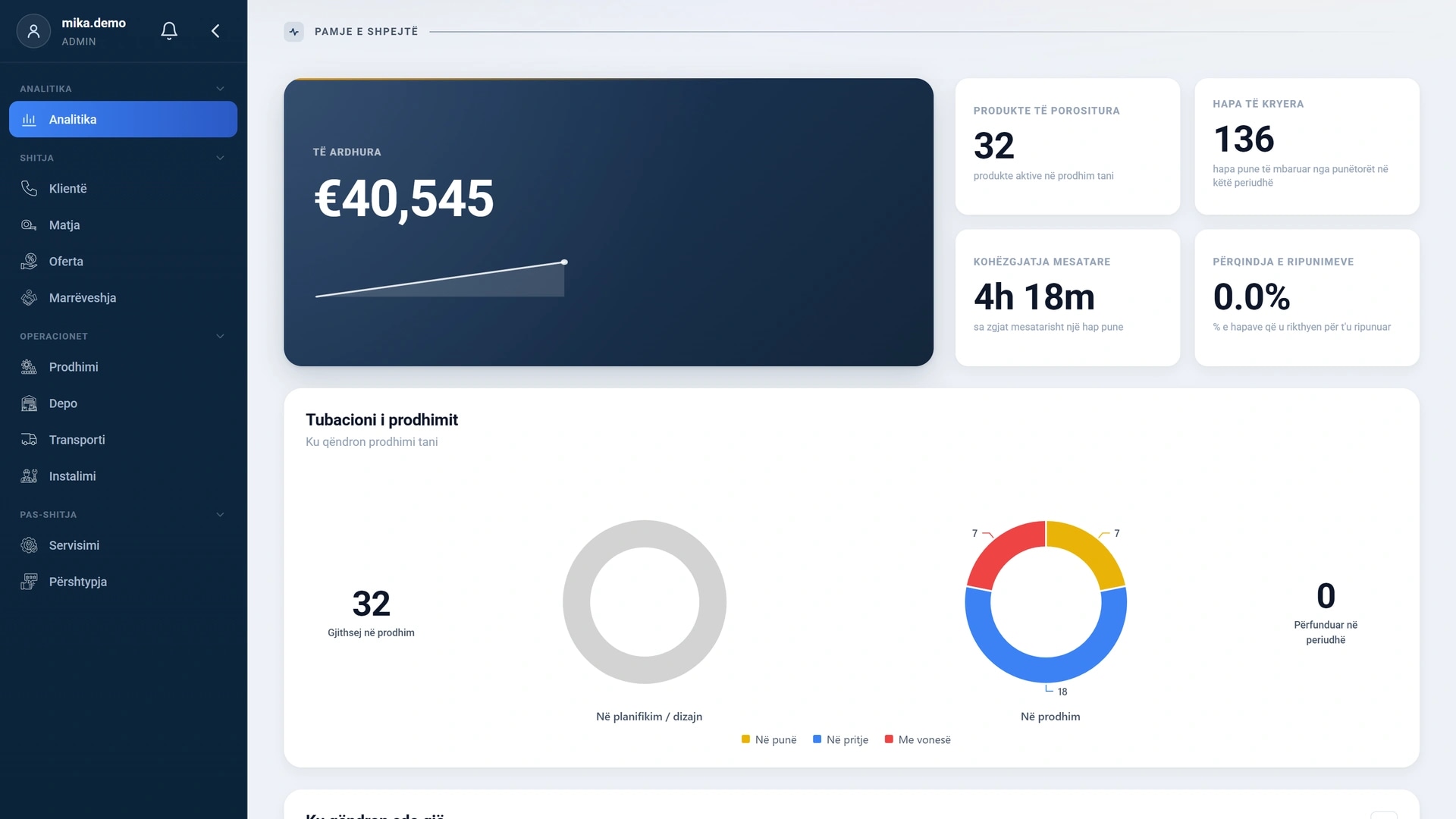
The order book as numbers: what is committed, how long a production step actually takes measured across every step completed in the period, and how much work comes back as rework. Delivery dates are usually promised from memory, and measured durations turn a promise into a calculation. Rework is the most expensive thing a factory does and the least likely to be written down, because the same people quietly fix it.
Articles
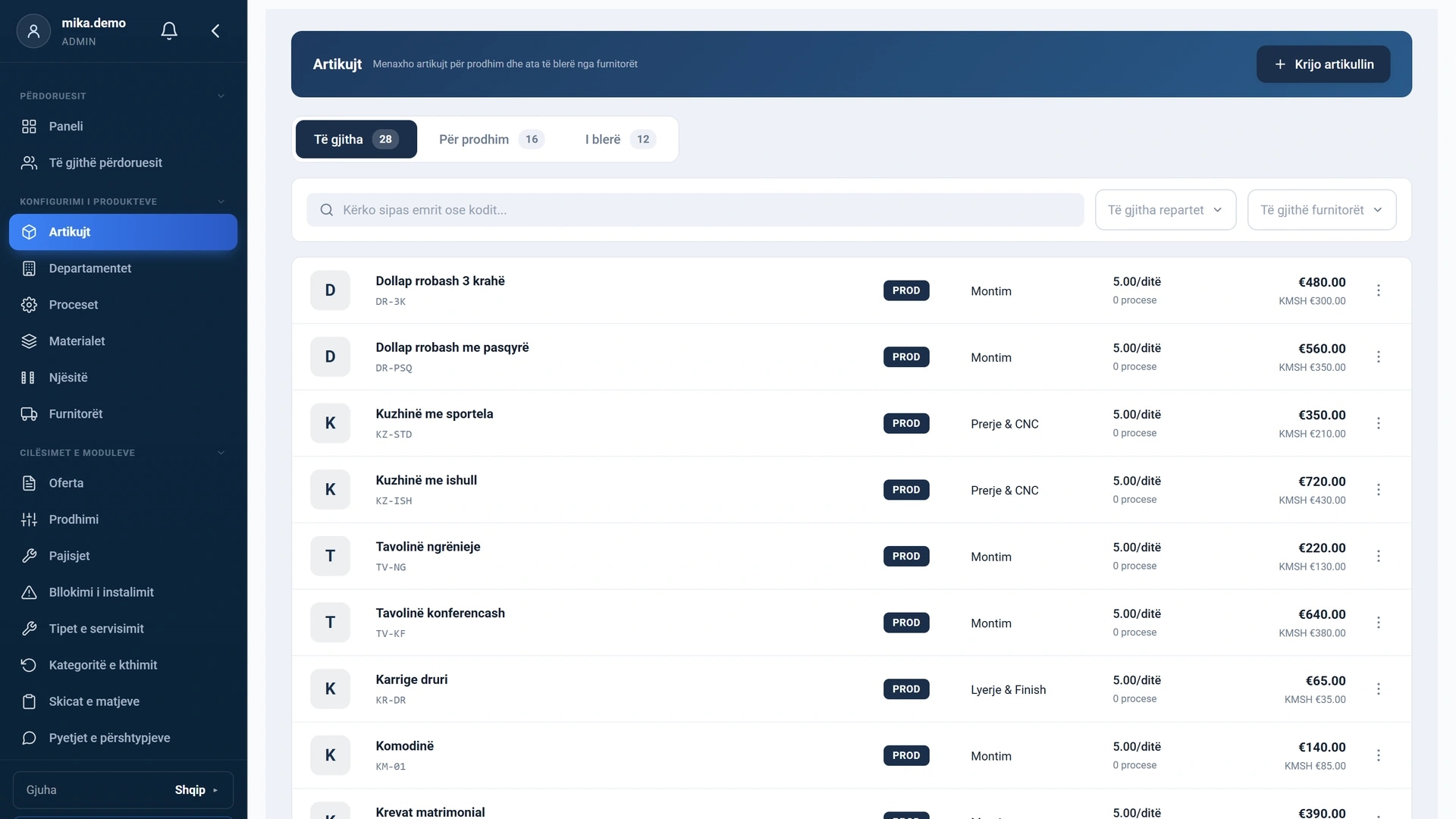
The catalogue the whole system is built from: what you manufacture, what you buy in, and what each one costs against what it sells for. Each article names the department it routes to, and that is what generates the production board, so defining the route once means every future order schedules itself instead of being planned by hand. Quoting from a price list without the cost beside it is how a factory discounts its way into a loss on a job it was proud to win.